
Introduction
Planning a successful marketing event often comes down to one critical stress factor: time. If your custom advertising umbrellas arrive after the trade show or product launch ends, even well-made gifts may miss their marketing purpose and commercial value.
As an experienced manufacturer handling international custom orders, Blueprint Umbrella understands that project deadlines are critical for buyers. In this guide, we explain practical timelines for MOQ, sampling, production, and shipping planning for custom golf, folding, and stick umbrellas, helping you manage your supply chain schedule from the very beginning.
1.Why Small-Batch Orders Usually Have a Higher Unit Price
Almost every supplier advertises “flexible minimum orders,” but how does it actually impact your real procurement costs? Let’s look at the transparent math and how the factory actually operates.
The Real Flexible MOQ:
For selected standard umbrella models and stock fabric colors, orders of 50 or 100 pieces may be possible. This provides great convenience for brands needing products for small executive meetings or regional testing.
Why Does the Unit Price Increase? T
he unit price for extremely small batches will naturally be noticeably higher than the bulk price for 1,000 pieces. The core reason is the allocation of fixed costs. As a simplified example, assume the fixed labor cost for plate making and machine calibration is $300. Spread over 1,000 pieces, it adds only $0.30 per umbrella. But spread over just 50 pieces, that fixed cost instantly jumps to $6 per umbrella. Add to that the slower manual adjustments required for initial production, and manufacturing costs rise accordingly.
A Smart Purchasing Strategy:
Although the unit price increases, small batches reduce upfront inventory pressure and entirely eliminate unnecessary dead stock risks. To keep your budget transparent, we strictly separate the “product cost” from the “express shipping fee,” ensuring expensive small-parcel shipping costs are never hidden inside the umbrella’s unit price.
2. Sampling Timelines: Managing a 6-Week Event Countdown
“The trade show is only 6 weeks away; I absolutely cannot afford to waste 2 weeks on sampling!” This is a common distress call we receive during peak event seasons.
Regardless of the printing method, sample time for printed umbrellas requires independent scheduling in the workshop. Here is a realistic timeline for producing a pre-production sample (PPS) using stock fabrics, along with standard bulk lead times:
| Printing Method | Added Factory Cost | Mass Production Time (Standard) |
|---|---|---|
| Standard Silkscreen | 7 – 10 Days (Subject to scheduling) | 30 – 35 Days |
| Full-Panel Dye Sublimation | 7 – 10 Days (Subject to scheduling) | 35 – 45 Days |
Note: The times above represent factory production only and do not include the additional 3-5 days needed for international express shipping of physical samples. You can refer to our custom umbrella printing guide to learn more about method differences and suitable scenarios.
Rush Order Strategy:
If time is extremely tight, waiting for international sample shipping followed by ocean freight is not realistic. For urgent, lower-complexity projects, online PPS approval through high-resolution photos and videos may save valuable time, but it is not ideal for complex brand colors, full-canopy artwork, or brand-new structures. Once approved, the production line will expedite the order, and bulk delivery can be routed via air freight or an expedited shipping line to further reduce transit time.
3. Mass Production Lead Times: Why 35–45 Days Is Common
Supply chain buyers often tell us: “Don’t give me a vague window; I need to book shipping vessels and arrange inland trucking in advance!”
We completely understand the pressure to meet ocean freight deadlines. However, for a standard order of around 1,000 pieces, we initially provide a baseline window of 35-45 days.
This is because the assembly line is dynamic, and the specific umbrella model directly impacts processing time. For example, standard custom folding umbrellas are relatively faster to produce due to mature processes. However, if you are ordering a complex double canopy custom golf umbrella, labor time increases significantly due to the manual precision required to align and stitch the wind-venting holes between the upper and lower canopies.
Accurate Booking Guide:
We provide an estimated window during the early assessment phase, and we will provide a more specific completion date once production is officially scheduled. On the day you officially approve the pre-production sample (PPS), our sales specialists will coordinate deeply with the workshop supervisor to confirm a more specific estimated mass production completion date, allowing you to confidently arrange international logistics and warehousing.
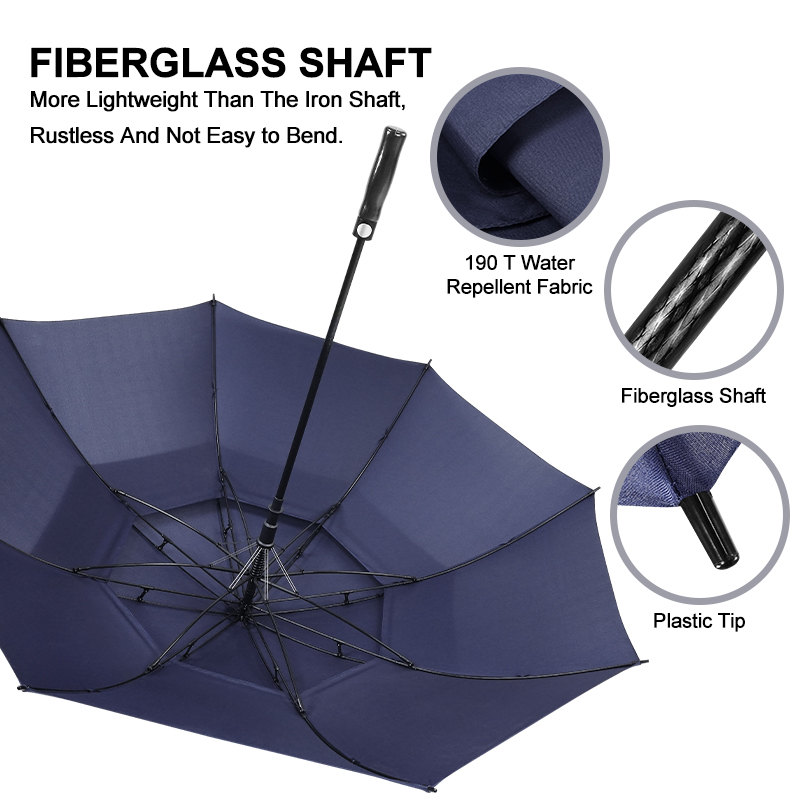
Umbrella fiberglass shaft and material specifications chart.
4. Behind the Scenes: Why Custom Umbrellas Take Time to Make
If your project manager or client is pressing for a faster delivery and asking, “Why does it take so many complex steps to make an umbrella?”, you can use this factory floor reality check to explain.
After a high-quality custom umbrella goes through the Large Cut and Small Cut (or Goring) phases, the real technical challenges begin:
Canopy Assembly (Sewing Gores Together): Accurately aligning a large logo across multiple panels requires experienced workers using positioning pins for manual stitching. Since the fabric has unavoidable stretch, workers must carefully control tension to keep visible misalignment within an acceptable range.
Sewing Canopy to Frame (Marriage): This is purely manual work. Machines cannot automatically identify the tiny frame joints, so workers must hand-tie and stitch the canopy to the metal or fiberglass ribs. Tying it too tightly can cause the fabric to tear in the wind, while tying it too loosely can cause it to flip off. This requires precise tension balance from the operators.
Quality Control (Inspection): Strict quality control for around 1,000 pieces often takes about 3 to 5 days. This includes using strong light boxes to carefully check for pinholes (leak risks), aggressive open/close testing, and meticulously trimming threads. The days spent here directly translate into the product’s longer lifespan.
5. Heavy Customization: Pantone Dyeing and Custom Mold Requests
If your client is a strict FMCG brand requiring a very close Pantone match for the fabric or a custom-molded handle in a highly unique shape, it is crucial to anticipate the following requirements when planning your timeline:
Pantone-Dyed Umbrella Fabric:
Fabric dyeing is no longer determined solely by the umbrella assembly factory but is restricted by the fabric mill’s minimum dye vat capacity. This means the MOQ may increase to around 2,500–3,000 pieces, and you will typically need to wait an additional 15 to 20 days for the fabric dyeing schedule.
Custom Molded Handles:
To offset the CNC tooling and injection machine setup costs, custom handles usually require an MOQ of 1,000 to 2,000 pieces, extending the custom umbrella lead time by an extra 15 to 25 days from mold testing to final sampling.
Practical Alternatives:
If the budget or timeline doesn’t allow for heavy customization, we suggest:
Using white stock fabric with full-panel dye sublimation to approximate your brand color across the entire canopy, which can help shorten the waiting time compared with custom fabric dyeing by several weeks.
Selecting a suitable existing handle option to avoid unnecessary tooling fees and significantly compress the lead time.
6. FAQ
Q: What is the realistic MOQ for custom advertising umbrellas?
A: For selected standard models and stock fabric colors, small orders such as 50 or 100 pieces may be possible. However, the unit price is usually higher because fixed costs such as setup, calibration, labor preparation, and packaging handling are shared across fewer units. If you require custom-dyed fabric, special handles, or fully customized packaging, the MOQ will usually be higher.
Q: How long does it take to produce a custom umbrella sample?
A: For most custom advertising umbrella projects using stock fabric, a physical pre-production sample usually takes around 7 to 10 days after artwork or 3D rendering is confirmed. International express shipping may add another 3 to 5 days depending on the destination and courier schedule.
Q: Can we skip the physical sample if our event deadline is very close?
A: For urgent and relatively simple projects, online PPS approval through high-resolution photos and videos may help save time. However, a physical sample is still recommended for complex artwork, strict Pantone matching, new structures, or premium retail projects to ensure final quality.
Q: How long does mass production usually take for custom umbrellas?
A: Standard mass production usually takes around 30 to 45 days after sample approval, depending on umbrella type, order quantity, printing method, current production schedule, and inspection requirements. Simple silkscreen projects on stock fabric are usually faster, while full-panel dye sublimation, double canopy golf umbrellas, or complex logo alignment may require more production time.
Q: Why does custom Pantone fabric increase the MOQ and lead time?
A: Custom Pantone fabric usually requires fabric mill yarn dyeing, which is controlled by minimum dye vat capacity rather than the umbrella assembly factory alone. This often increases the MOQ and may add around 15 to 20 days to the production schedule. For lower-MOQ projects, stock fabric colors or full-panel dye sublimation may be more practical alternatives.
Q: Can you help us choose the fastest production option for an event deadline?
A: Yes. If you provide your target event date, preferred umbrella type, logo files, quantity, delivery country, and budget range, we can help evaluate whether stock fabric, silkscreen printing, digital sublimation, air freight, or online sample approval would be the most practical route for your timeline.