
- Introduction
- 1. What Actually Determines UV Transmission Through an Umbrella Canopy
- 2. Black, Silver, and Color Coatings: What Buyers Should Compare
- 3. Common UV Claims — and What They Do and Don’t Mean
- 4. Fabric UPF vs. Protection Under an Umbrella
- 5. UV Protection Across Umbrella Types: Golf, Folding, Straight
- 6. How to Specify UV Protection for a Custom Order
- 7.FAQ
- 7.Final Checklist Before You Order
Introduction
If you are sourcing umbrellas for an outdoor program — a golf event, a beach activation, a corporate gift people actually carry — you have probably seen the same question appear again and again, in search and in RFQs: does an umbrella block UV, and how do you know the one you order actually does?
That question keeps coming up for a fair reason: outdoor branding and events mean the canopy is something people stand under for hours. When a logo goes on a canopy, the person holding it reasonably wants to know what that canopy is doing for them beyond keeping rain off. It deserves a straight answer instead of a marketing line.
This guide walks through what determines UV shading on a custom umbrella, the three coatings we work with, the claims you will meet, and how to specify it without overpromising — across golf, folding, and straight umbrellas alike.
1. What Actually Determines UV Transmission Through an Umbrella Canopy
The short version: it is the canopy fabric and how it is finished, not the frame. UV protection can come from the interaction of several factors — fabric construction, color, UV-absorbing additives, and protective coatings — and these mechanisms can overlap: a coating may itself contain UV absorbers, while the base fabric also influences UV transmission. For procurement, the key question is not simply which treatment is used, but whether the selected fabric and coating combination has been tested for the required level of UV protection.
Several factors influence UV transmission through umbrella fabric:
The base fabric
Umbrella pongee can be made from virgin or recycled polyester. UV transmission depends on the finished fabric construction, yarn, dyes, and treatments; the recycled-content label alone does not establish UV performance. Fabric weight, construction, and color can influence UV transmission, but none of these factors alone establishes a UV rating — assess the finished material using the relevant test results.
Weave density
Tighter weaves leave fewer gaps for light to pass through, which is one reason we commonly source 190T and 210T pongee — but thread count alone does not establish UV protection. Compare the complete fabric specification and the relevant test results.
The coating on the back
A backing coating can change how the canopy transmits, reflects, and absorbs radiation. Its UV performance depends on the selected formulation and finished fabric construction — see the coatings section below for how we specify it.
Color also matters
Darker canopies often read as more shading, but color is only one factor. A darker canopy does not automatically carry a higher UV rating; the fabric spec — not color alone — is what confirms performance. Compare test results for the specified fabric, coating, and finish.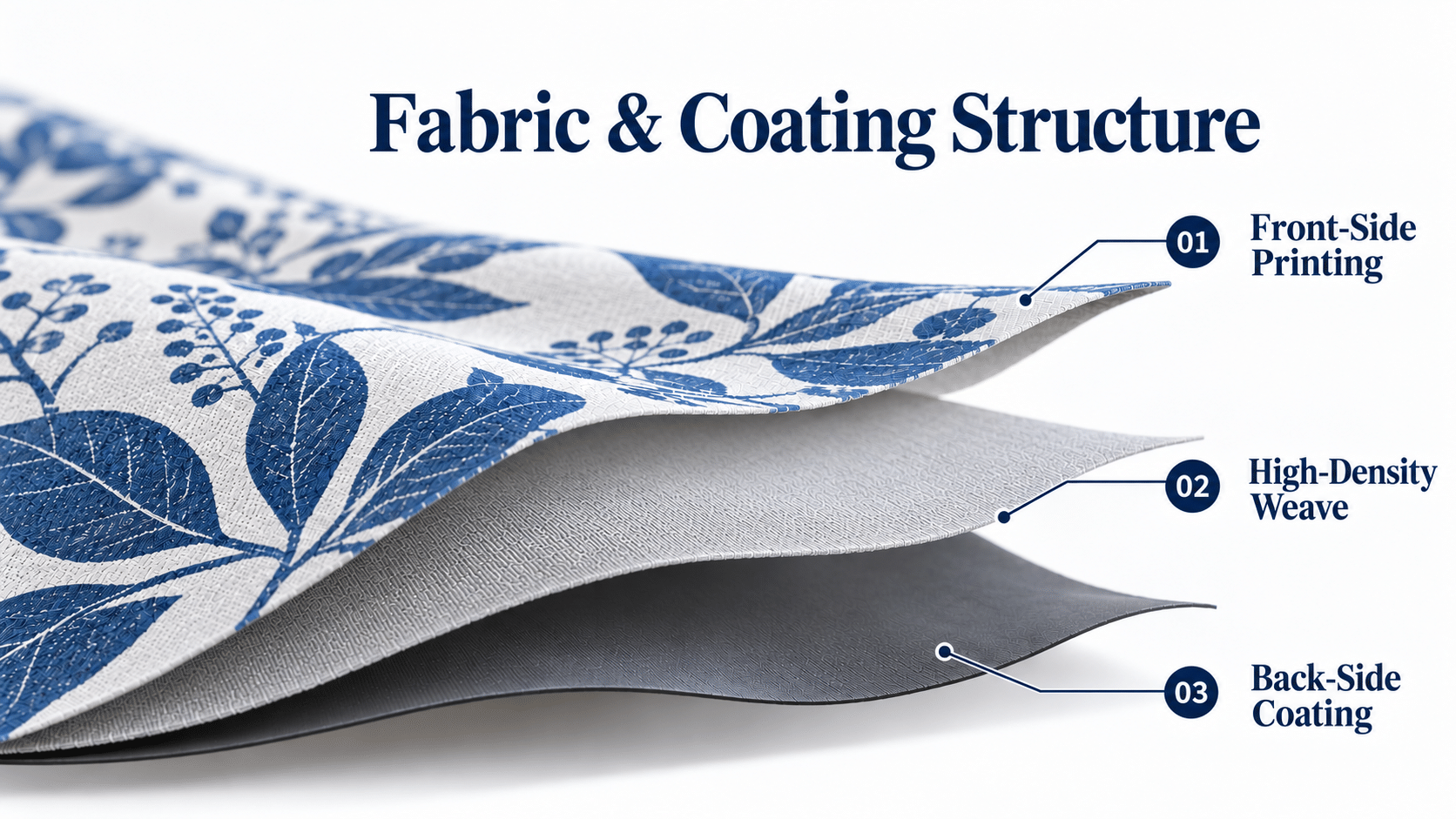
2. Black, Silver, and Color Coatings: What Buyers Should Compare
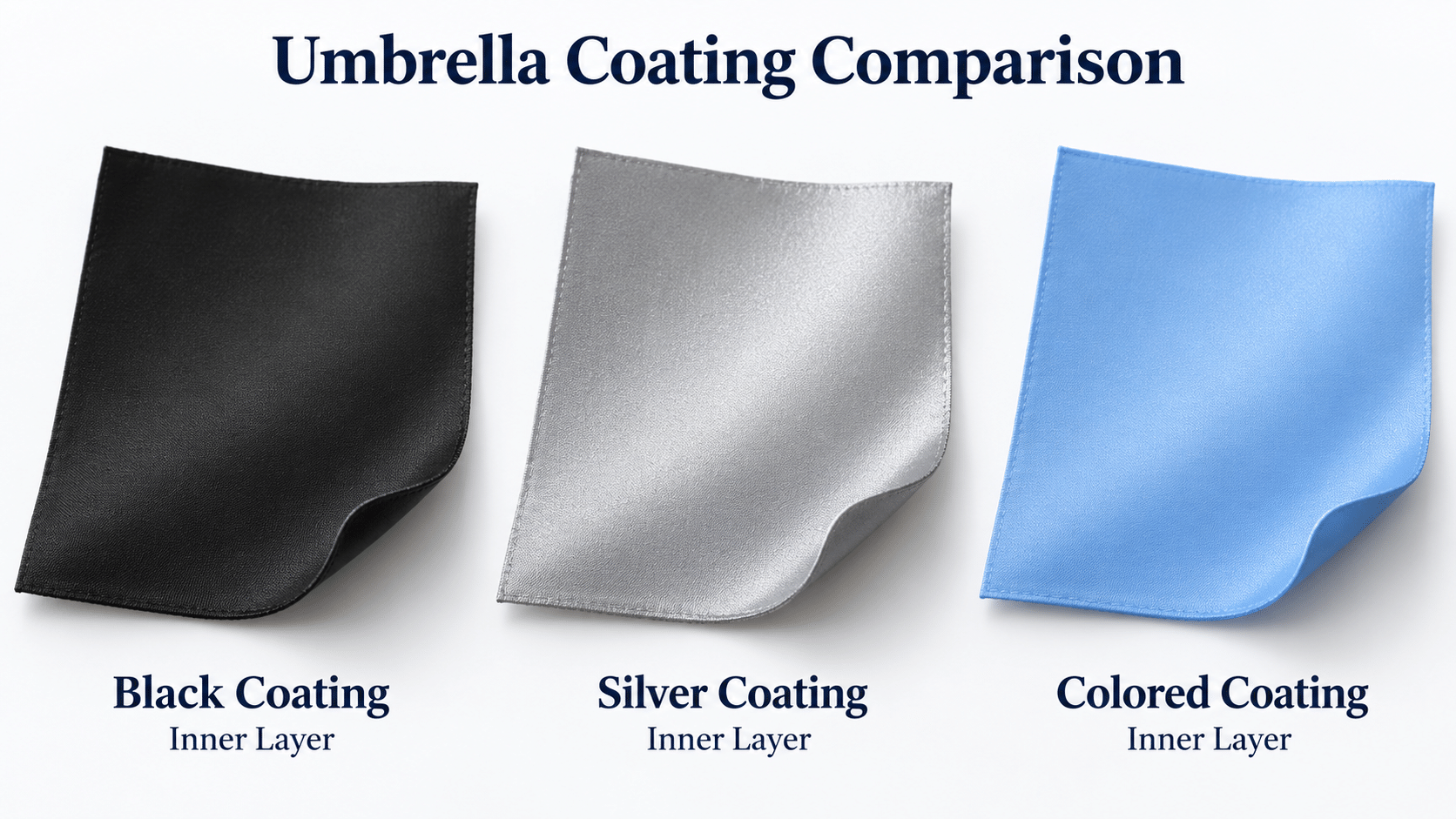
When buyers ask about UV, what they are usually reacting to is the canopy’s backing. We work with three coating families, and the difference between them is practical, not just cosmetic. The key is to separate what each one looks like and how it feels from what a test report actually supports.
Black coating
A black-coated backing has strong visible-light absorption, which gives a darker, lower-glare view under the canopy. That visual shading is a real benefit, but it is not the same as a measured UV rating — the actual UV result still depends on the tested fabric and coating combination. For programs where a dimmer under-canopy environment is the priority, black coating is often a good fit; evaluate its UV performance against the specific material, not the coating name.
Silver coating
Silver coating provides a metallic backing. Its UV performance and any effect on thermal comfort should be evaluated for the selected fabric-and-coating construction. It also gives a clean, technical look from underneath, and is a long-standing, widely specified UV backing for promotional and corporate canopies.
Color coating
Color coating provides a colored backing that may also be formulated for UV protection. Confirm the available colors, approved shade, and UV test results for the selected formulation. For programs where the brand color must stay visible in the inner layer, color coating lets you keep that color while still specifying UV shading, instead of hiding it behind a dark or metallic back.
How to choose among the three
- Choose black coating for a darker, lower-glare under-canopy view; judge UV performance per material combination.
- Choose silver coating for a metallic, neutral backing; request separate evidence for any cooling or thermal-comfort claim.
- Choose color coating to keep a brand color visible in the inner layer while still specifying UV shading; confirm available colors and the approved shade.
At a glance: black vs silver vs color
| Coating | Appearance | What to verify | Selection priority |
|---|---|---|---|
| Black | Dark, low-glare under-canopy view | UV result for the tested fabric-and-coating construction | When a dimmer under-canopy environment is the priority |
| Silver | Metallic backing, technical look | UV performance; separate evidence for any thermal-comfort claim | When a metallic, neutral appearance is wanted |
| Color | Colored backing carrying the brand color | Available shade and UV results for the selected formulation | When the inner-canopy color must stay visible |
Compare the three coatings against your program’s appearance and performance requirements, then confirm availability for the selected umbrella model and canopy specification.
3. Common UV Claims — and What They Do and Don’t Mean
As you compare suppliers, you will meet a few recurring terms:
- “UV protection” / “sun protection” — a general description of shading. On its own it is not a measured rating.
- “UPF” — a rating that should be supported by testing applicable to the specified canopy material and by the relevant product-labeling requirements. UPF indicates how effectively a tested textile reduces erythemally weighted UV transmission under specified test conditions. A higher UPF means lower weighted UV transmission through the tested material. One fabric report does not establish the same rating for every umbrella model, color, or construction. Test methods and labeling rules vary by market (for example, Australian shade structures reference standards such as AS 4174; see ARPANSA for UV background), so confirm the basis for the claim you intend to use.
- “SPF” vs “UPF” vs other ratings — SPF is used for sunscreens. Textile UV performance may be reported using UPF, while other rating systems apply in some markets. For example, ARPANSA uses UVE ratings under AS 4174 for shade fabrics, including umbrella applications. Confirm the test and labeling basis for your destination market.
- Certification language — we do not advertise a UV certification we do not hold. What we can do is point you to the test report for the exact canopy fabric you choose.
We avoid stating a single UPF number for the whole umbrella line, because one material report does not automatically support the same claim across every finished umbrella specification. For the test method behind fabric UV testing, see the AATCC TM183 overview; for why UV exposure matters and how shade fits into protection, see Cancer Council Australia.
4. Fabric UPF vs. Protection Under an Umbrella
Fabric UPF is not the same as protection under an umbrella. A fabric test measures UV transmission through the tested material. Actual protection also depends on canopy size, umbrella position, sun angle, and scattered or reflected UV entering around the edges — including reflection from surfaces such as water or sand. Use an umbrella alongside other appropriate sun-protection measures; bodies such as Cancer Council advise that shade should be combined with other sun protection. A test report tells you what the material does, not the full UV exposure a person experiences while holding the umbrella.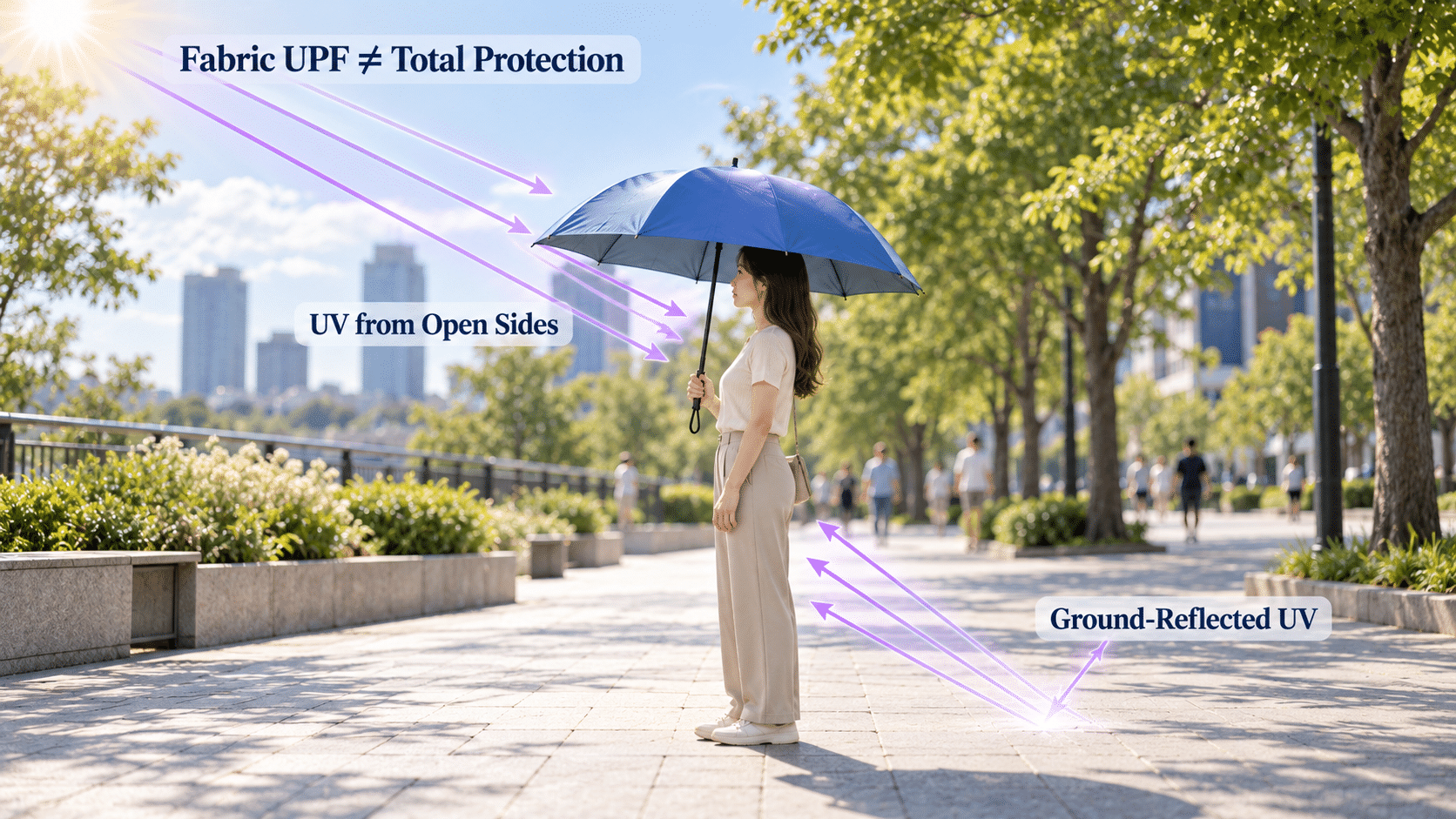
5. UV Protection Across Umbrella Types: Golf, Folding, Straight
A useful point that gets missed: UV protection is specified at the canopy level, so it can apply across our main umbrella lines. The coating is not limited to one shape — but umbrella type does not by itself determine a material’s test result, and canopy size and design still affect the coverage a user actually gets.
Golf umbrellas
Golf umbrellas can be specified with canopy materials tested for UV protection. Select the fabric, any coating or treatment, and canopy size around the intended outdoor use — long rounds and course-side activations put the canopy in open sun for extended periods.
Folding umbrellas
Folding umbrellas can combine a compact format with a tested UV-protective canopy. Available coverage depends on the open canopy dimensions, while the opening mechanism may be manual or automatic.
Straight umbrellas
Straight (long-handle) umbrellas — including wood-handle gift styles — can also be specified with canopy materials tested for UV protection. For corporate gifts people keep and use outdoors, a UV-protective straight umbrella pairs the classic look with practical sun shading.
Across golf, folding, and straight umbrellas, confirm the canopy material and any coating or treatment. Then assess canopy size and design for the coverage your program needs. UV shading matters most for outdoor events and activations, golf and club programs, and corporate gifts people keep and use outdoors — a useful umbrella can keep your branding visible through repeated outdoor use.
6. How to Specify UV Protection for a Custom Order
The practical step is simple: ask for the test report on the exact canopy fabric you specify.
Tell your supplier the use — an outdoor event, a daily-commute giveaway, a golf program — and request the fabric’s UV-related test result in writing. A good factory can name the fabric grade and share the available documentation so the claim is backed, not assumed. If a supplier answers a UV question with only a slogan, that is the signal to ask for the paper.
Before placing a bulk order, confirm that the available UV test report corresponds to the specified canopy fabric and coating combination. If the material, coating, or finishing process changes, check whether the existing test report remains applicable or whether additional testing is needed. AATCC TM183 measures UV transmission and blocking for textile fabrics (including dry and wet specimens), so matching the test report to the fabric you actually buy is the single most important procurement principle in this guide.
Confirming a colored inner layer. For a program that needs a colored inner layer, confirm the available shade for the selected coating formulation, the fabric-and-print combination, and whether the available UV report applies. If it does not, agree on any additional testing before production. The same discipline applies whether the canopy is golf, folding, or straight.
We work on a flexible MOQ and can source canopy fabrics and share the available test documentation for the specific fabric, so your program’s sun-protection claim rests on documented canopy specifications and applicable test results.
7.FAQ
Q:What is the difference between black, silver, and color coating?
A:Black coating typically has strong visible-light absorption; silver coating provides a metallic backing whose UV performance and thermal effect should be evaluated per construction; color coating provides a colored backing that may also be formulated for UV protection. All three are canopy coatings; availability for a specific umbrella model should be confirmed against the selected fabric and coating combination.
Q: Can UV protection be combined with a custom umbrella print?
A:Yes. depending on the selected fabric, coating, and printing method. The production sequence should be confirmed for the specific combination. Before mass production, we recommend verifying that the selected material specification and available UV test documentation match the intended canopy construction.
Q:Does UV coating work on golf, folding, and straight umbrellas?
A:UV-protective canopy options can be available for golf, folding, and straight umbrellas. Confirm availability and test support for the selected model, fabric, and coating combination.
Q:Does a higher thread count (190T vs 210T) mean better UV protection?
A:Thread count alone does not establish UV protection. A tighter weave is one factor, but compare the complete fabric specification and the relevant test results rather than assuming 210T is automatically better than 190T.
7.Final Checklist Before You Order
If you are specifying UV protection for a custom umbrella program, run through this list — and check the test report against your actual order specification, not a generic claim:
- Sample match — confirm the report covers the exact fabric code, color, coating, print, and finishing process you are ordering.
- Method and result — note the test method used and what rating or claim the report actually supports.
- Test conditions — check whether results are for dry, wet, or any aged / durability-treated state.
- Change control — if you change color, coating, or print, verify whether the existing report still applies or new testing is needed.
- Final copy — make sure the wording on the product page, hangtag, and packaging matches the evidence.
- Confirm the use case — event, commute giveaway, or golf / club program — and the lead time around your ship window.
A UV-protective umbrella is more than rain cover — it is shade your recipients will actually stand under. As a custom umbrella manufacturer since 2007, we can spec the canopy, coating, and print around your program.